




















Remote is a strong global platform with published prices and two clear paths in Singapore: EOR from $599 per employee per month if you have no entity, and Global Payroll from $29 if you own one. If you are paying the EOR rate for staff you could employ yourself, the first question is which path you should be on. This guide covers that question, what changes on your own entity (including the 1 January 2027 CPF rate change), and four alternatives: Omni HR, Employment Hero, Deel and Multiplier.
Why This Guide Exists
Remote (remote.com) is a well-built global employment platform, and it does several things better than most. It publishes its Singapore prices on its Singapore page, in US dollars, without a demo. It names IRAS and CPF Board correctly. It lists the Skills Development Levy as its own line. It correctly says Singapore has no statutory minimum wage, and it correctly leaves out 13th month pay, which Singapore does not require. It offers human support 24 hours a day on weekdays, an AI assistant around the clock, and a named Payroll Service Level Agreement.
So this guide is not an argument that Remote is a bad choice. It is for one specific reader: a company paying Remote's EOR rate for Singapore staff, who has, or is setting up, its own Singapore entity.
If that is you, two questions matter more than which vendor you pick.
- Are you on the right path? EOR and own-entity payroll are different products at very different prices.
- If you move onto your own entity, who handles the Singapore filings? With EOR, the provider is the employer. On your own entity, you are.
We read each vendor's Singapore pages on 26 October 2026 and set them against the rules from CPF Board, IRAS and the Ministry of Manpower (MOM). Here is what we found.
Quick Comparison
| Platform | Best for | Payroll on your own Singapore entity | Singapore EOR price | Payroll price | Rating |
|---|---|---|---|---|---|
| Omni HR | Singapore teams moving staff onto their own entity, with more Asian markets ahead | Yes, native. CPF, SDL, IRAS and FWL | EOR available across Asia | $3/employee/mo core platform, plus Singapore payroll from $4 | 4.8/5 (G2) |
| Employment Hero | SME teams that want SGD pricing and an easy HR interface | Yes, native, priced in SGD | Not published | Payroll SGD 6 or 8, plus HR SGD 5 to 10, each with its own monthly minimum | 4.4/5, 239 reviews (GetApp) |
| Deel | Teams that want to stay on a global platform and hire in many countries | Yes, Global Payroll "if you have an entity" | From $599/mo | $29/employee/mo, global | 4.9/5, 4,318 reviews (GetApp) |
| Multiplier | Teams staying on EOR that want the lowest published EOR headline | Its Singapore payroll page directs established entities to its EOR | $459 (Core) or $519 (Growth), billed annually | $20/person/mo, global, plus fees "as applicable" | 4.4/5, 45 reviews (GetApp) |
| Remote (for reference) | Teams spread across many countries | Yes, Global Payroll "for paying employees in countries where you own the entity" | From $599/mo | From $29/employee/mo | 4.3/5, 102 reviews (GetApp) |
Vendor prices and ratings read on each vendor's own pages and on GetApp, 26 October 2026. Prices in USD unless marked SGD. EOR and payroll are different purchases, so compare down each column, not across.
Why Singapore Teams Look for Remote Alternatives
The reasons to look are specific, not about quality. And the first one may be a reason to stay with Remote on a different plan.
You may be paying an EOR rate for staff you could employ yourself
Remote's Singapore page carries a price block headed "Transparent Pricing in Singapore". As of 26 October 2026, it shows two paths side by side:
| Remote path | Who it is for, in Remote's words | Price |
|---|---|---|
| Employer of Record | "For hiring employees in countries where you don't have an entity yet." | "Starting at $599" per employee per month |
| Global Payroll | "For paying employees in countries where you own the entity." | "Starting at $29" per employee per month |
Credit to Remote for spelling this out on the country page itself. Its Global Payroll bullets also say "Remote Platform included, no base fee", and its pricing FAQ says there are "no setup or onboarding fees".
The gap is large. At the headline, EOR costs about 20 times the Global Payroll price. EOR makes sense when you have no Singapore entity, because the provider becomes the legal employer of your staff. Once you have your own Singapore company, that reason may no longer apply.
So ask yourself first: do we have, or plan to set up, our own Singapore entity? If yes, the cheapest change might be inside Remote, from EOR to Global Payroll. If you are making that move anyway, it is also a good moment to compare who does Singapore payroll best.
On your own entity, the filings become yours
With EOR, the provider is the legal employer. On your own entity, you are, and these Singapore rules land on your payroll team.
- CPF is three rate tables, not one. Singapore Citizens and Permanent Residents (PRs) from year three use one table. PRs in their first and second years use two others. Foreign employees on an Employment Pass, S Pass or Work Permit pay no CPF at all (CPF Board).
- The wage ceilings. The Ordinary Wage ceiling is $8,000 a month from 1 January 2026. The annual salary ceiling is $102,000, so the ceiling for bonuses depends on how much Ordinary Wage each person has earned that year (CPF Board).
- A rate change is coming on 1 January 2027. CPF rates rise for employees aged above 55 to 65. The total rate for ages above 55 to 60 moves to 35.5%, up 1.5 points. For ages above 60 to 65, it moves to 26%, up 1 point (CPF Board). Your payroll system has to switch rate tables on the right date.
- SDL covers foreign staff too. The Skills Development Levy is 0.25% of monthly total wages, with a minimum of $2 and a maximum of $11.25 per employee. It is owed "for all your employees working in Singapore, including foreign employees", even those with no CPF (CPF Board).
- The Foreign Worker Levy (FWL) is a separate payment. It goes to MOM, not CPF Board, by the 17th of the following month. It is pro-rated by day from the date a pass is issued to the date it is cancelled. The S Pass levy was set at $650 across all sectors from 1 September 2025 (MOM).
- Year-end filings. Form IR8A is required by law for all employees. Electronic submission through the Auto-Inclusion Scheme (AIS) is mandatory for employers with five or more employees, by 1 March (IRAS). Five employees is not a big-company rule. Almost every growing team is in scope.
- Departing foreign staff. Form IR21 tax clearance must be filed at least one month before a non-citizen employee stops working for you or leaves Singapore for more than three months, and you must hold back all money due to them. Late or missing filing can bring a fine of up to $5,000 (IRAS).
None of this is unusual. But on EOR, someone else carried it. On your own entity, your payroll system has to.
What Remote's Singapore page names, and what it doesn't
Remote's Singapore page names CPF, the Skills Development Levy, IRAS and CPF Board. As of 26 October 2026, these terms appear zero times on that page:
- "IR8A"
- "Auto-Inclusion" and "AIS"
- "IR21" and "tax clearance"
- "Foreign Worker Levy", "S Pass", "Employment Pass" and "Work Permit"
This tells you what Remote's page says, not what Remote's product does. We read a web page, not a payroll engine. If these filings matter to you, ask Remote, and every other vendor here, to show you an IR8A submission and an FWL month live.
1. Omni HR
Best for: Singapore companies moving staff from EOR onto their own entity, who want HR and payroll in one platform and may grow into more Asian markets.
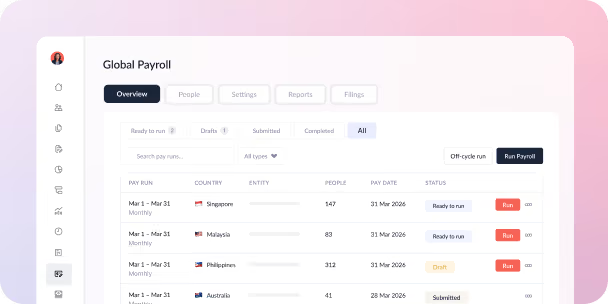
Omni HR is an HR and payroll platform built for Asia. It has native payroll in Singapore, Malaysia, Hong Kong and the Philippines, plus managed payroll across 20+ Asian countries, EOR across Asia and contractor payments across Asia.
| Capability | Omni HR | Remote |
|---|---|---|
| Payroll on your own Singapore entity | Yes, native Singapore payroll | Yes, Global Payroll, "for paying employees in countries where you own the entity" |
| Singapore items covered | CPF, SDL, IRAS and FWL. Files CPF, submits IR8A through AIS, handles work pass holders | Names CPF and SDL on its Singapore page. IR8A, AIS and FWL not on that page as of 26 Oct 2026 |
| EOR | Across Asia | From $599 per employee/mo in Singapore |
| Payroll pricing | $3/employee/mo core platform, plus Singapore payroll from $4 | From $29 per employee/mo, "Remote Platform included, no base fee" |
| HR, recruiting and performance | Core HR, an AI-assisted applicant tracking system and performance reviews built for Asian business cultures, in one platform | Global employment platform covering EOR, payroll and contractors |
| Support | WhatsApp, Slack and email, with same-day responses during Asian business hours in current practice | RemoteAI 24/7, human Live Messaging 24/5, and a named Payroll Service Level Agreement |
| Rating | 4.8/5 (G2) | 4.3/5, 102 reviews (GetApp) |
Singapore payroll, with the rules built in
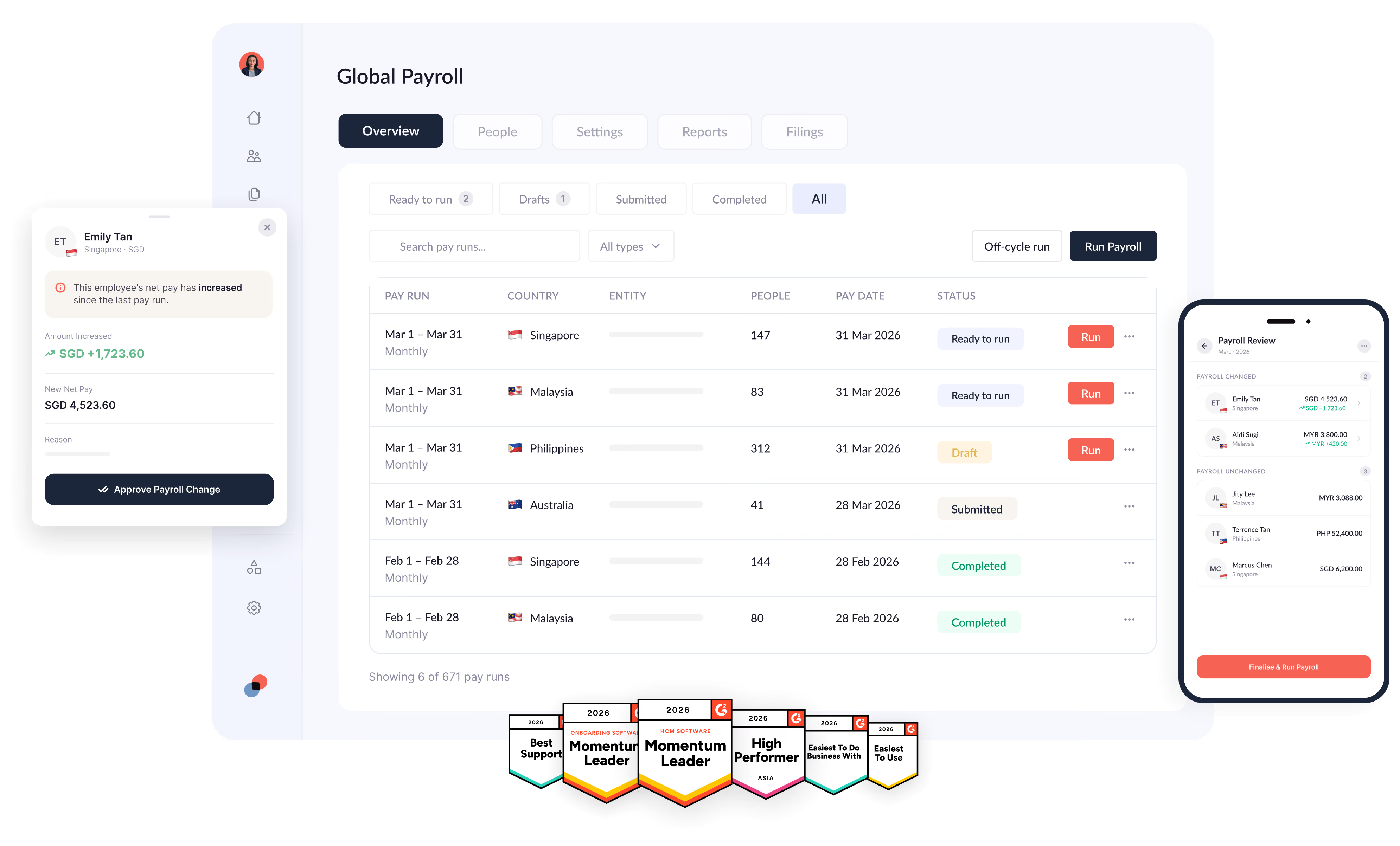
Omni HR's Singapore payroll covers CPF, SDL, IRAS and the Foreign Worker Levy. Omni HR files CPF, submits IR8A through AIS, and handles the Foreign Worker Levy and work pass holders. Your team runs payroll. The Singapore rules are already in the system.
One platform as you grow
If an EOR hire moves onto your own books, or a contractor becomes an employee, you stay on the same platform. The same is true when you add a team in Kuala Lumpur, Hong Kong or Manila. HR, recruiting, performance and payroll sit in one place. Mino, our agentic AI assistant, and Connect AI are available today.
Works where your team already works
Omni HR connects with Slack, Microsoft Teams, Xero, Google Workspace and Microsoft 365. One honest gap: the Omni HR mobile app does not cover the full suite, though leave requests and approvals work on mobile through Slack and Microsoft Teams.
Support you can message
You can reach Omni HR on WhatsApp, Slack or email, with same-day responses during Asian business hours. That is how we perform today, not a contractual commitment.
Pricing
Omni HR is $3 per employee per month for the core platform, plus Singapore payroll from $4 per employee per month, with no published setup fee. Compare that with Remote's Global Payroll from $29. EOR is a different purchase, so compare EOR prices separately.
Book a demo to see Singapore payroll in Omni HR.
2. Employment Hero
Best for: Singapore SMEs that want local pricing in SGD and a very easy HR interface.
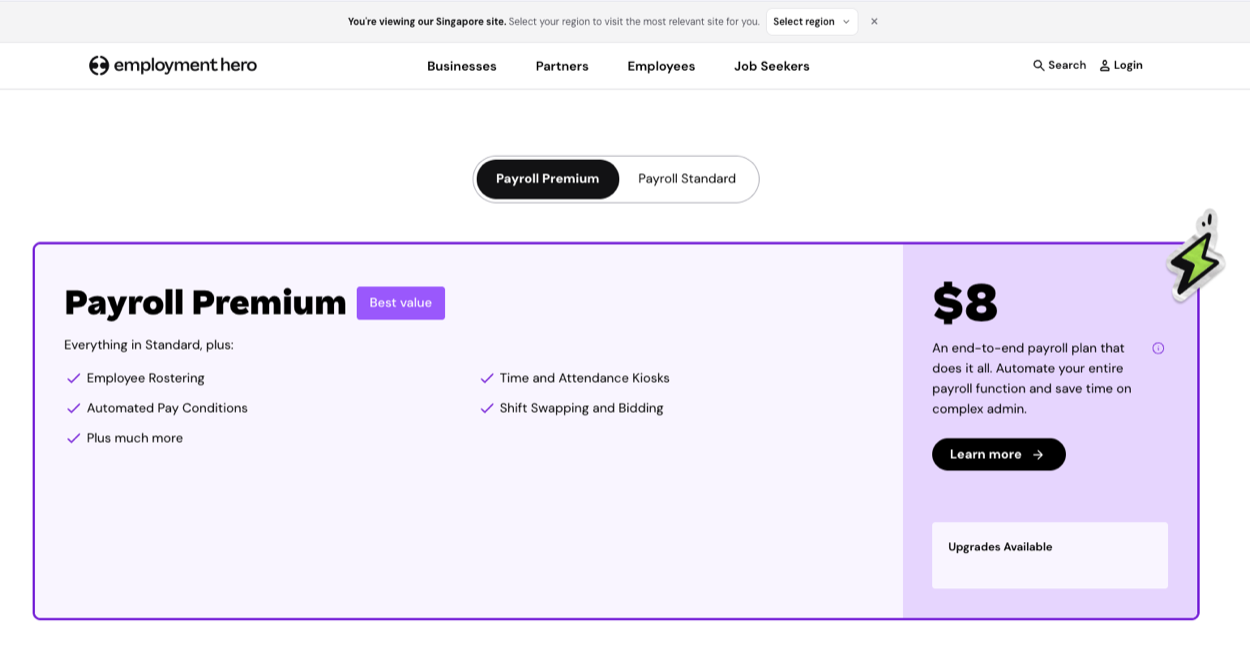
Employment Hero offers native Singapore payroll, priced in Singapore dollars per active employee per month. As of 26 October 2026, its Singapore pricing page lists Payroll Standard at SGD 6 (minimum charge $120 a month) and Payroll Premium at SGD 8 (minimum $160 a month). Payroll Standard lists "IRAS Compatible" and CPF reporting. Its help centre documents SDL as a payroll calculation, as of August 2026.
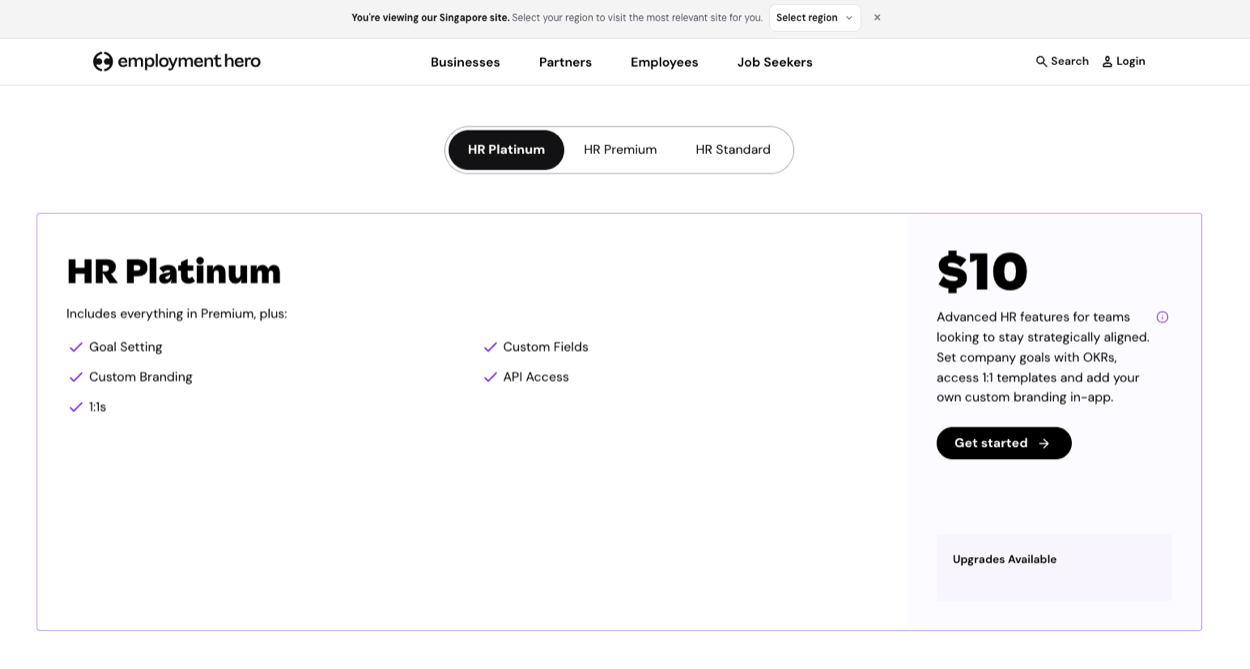
HR is a separate plan ladder: HR Standard at SGD 5, HR Premium at SGD 7 and HR Platinum at SGD 10, each with its own monthly minimum. A full HR and payroll stack runs SGD 11, 15 or 18 per employee per month, with combined minimums of SGD 220, 300 or 360. Billing is "based on the greater of any minimum contractual amounts and actual billable employees each month."
Employment Hero also offers EOR across 180 countries by its own count. Its Singapore EOR page shows no price, as of 26 October 2026. It publishes Southeast Asia support hours of 8.30am to 5.30pm Malaysia Time, Monday to Friday, as of August 2026.
The honest limitation is fit, not quality. HR and payroll are two plans, with two minimums. And as of 21 August 2026, we could not find the Foreign Worker Levy described as a product capability anywhere on Employment Hero's Singapore site or help centre. If you employ S Pass or Work Permit holders, confirm FWL handling with them directly.
Rating: 4.4/5, 239 reviews (GetApp, as of 26 October 2026).
3. Deel
Best for: Companies that want to stay on a global platform, hiring employees and contractors in many countries.
Deel is the closest like-for-like switch from Remote. As of 26 October 2026, both paths carry the same headline price as Remote. Deel's Singapore EOR starts at $599 per month. Its Global Payroll is $29 per employee per month, covering "130+ countries" with "country-specific tax filings, statutory reporting, and local compliance". Its Singapore page says: "If you have an entity, our Global Payroll solution takes care of payroll and compliance for your direct employees." Deel's EOR plan lists "24/7 support".
Deel's Singapore page names CPF, with 17% as the maximum employer rate, and a Skill Development Fund at 0.25%. As of 26 October 2026, "IR8A", "IR21" and "Foreign Worker Levy" each appear zero times on that page.
The honest limitation is about your goal. If you want to cut cost by moving from EOR to your own entity, moving from Remote to Deel does not change the headline price of either path. Deel suits a team whose main need is global reach.
Rating: 4.9/5, 4,318 reviews (GetApp, as of 26 October 2026).
4. Multiplier
Best for: Teams that will stay on EOR in Singapore and want the lowest published EOR headline.
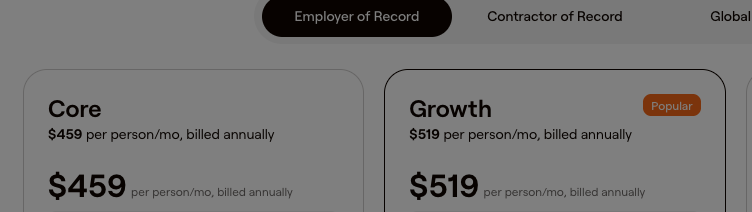
Multiplier is headquartered in Singapore. As of 26 October 2026, its Singapore EOR page says "plans starting at $459 per employee/month, billed annually". Its pricing page lists Core at $459 and Growth at $519 per person per month, billed annually, plus "Compliance mandated add-ons + Implementation fee as applicable". Its FAQ said there is no minimum headcount ("You can hire a single employee"), as of August 2026.
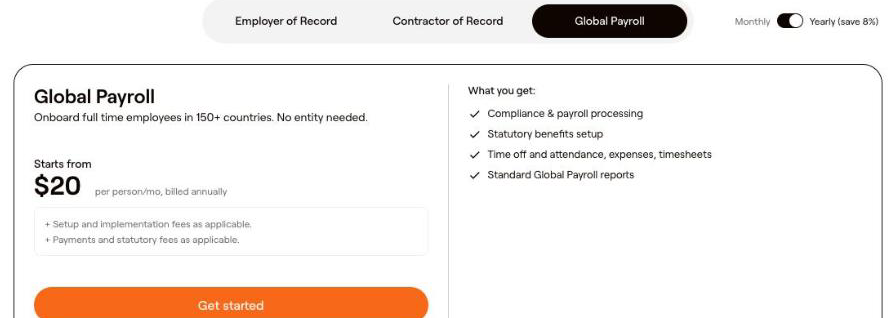
Multiplier sells Global Payroll at $20 per person per month, billed annually, plus setup, implementation, payment and statutory fees "as applicable". Its Singapore payroll page lists "Automates CPF" and "Handles SDL and levies: Calculates and submits through CPF EZPay."
The honest limitation, for this reader: as of 26 October 2026, Multiplier's Singapore payroll page directs established entities to its EOR. It says: "For established entities, Multiplier's EOR in Singapore ensures full compliance and seamless global expansion." If you are moving staff onto your own Singapore entity, ask Multiplier directly whether Global Payroll covers it.
Rating: 4.4/5, 45 reviews (GetApp, as of 26 October 2026). A small sample, so weigh it lightly.
Singapore Payroll on Your Own Entity: Who Covers What
| Omni HR | Employment Hero | Deel | Multiplier | Remote | |
|---|---|---|---|---|---|
| Own-entity Singapore payroll | Native | Native, SGD pricing | Global Payroll, "if you have an entity" | Singapore page directs established entities to EOR | Global Payroll, "where you own the entity" |
| Payroll price | $3 core + SG payroll from $4/employee/mo | SGD 6 or 8 payroll, plus SGD 5 to 10 HR, with minimums | $29/employee/mo | $20/person/mo, plus fees as applicable | From $29/employee/mo |
| Singapore EOR price | EOR across Asia | Not published | From $599/mo | $459 or $519, billed annually | From $599/employee/mo |
| CPF and SDL | Yes, both | CPF reporting on pricing page, SDL in help centre (Aug 2026) | Both named on SG page | Both named on SG payroll page | Both named on SG page |
| Foreign Worker Levy | Yes, with work pass holders | Not found as a capability (21 Aug 2026) | Not on SG page (26 Oct 2026) | "Handles SDL and levies" | Not on SG page (26 Oct 2026) |
| IR8A and AIS | Submits IR8A through AIS | Not part of our check | IR8A not on SG page (26 Oct 2026) | Not part of our check | Not on SG page (26 Oct 2026) |
| HR and payroll | One platform | Two plans, two minimums | One platform, several products | One platform, several products | One platform, several products |
| Rating | 4.8/5 (G2) | 4.4/5, 239 reviews (GetApp) | 4.9/5, 4,318 reviews (GetApp) | 4.4/5, 45 reviews (GetApp) | 4.3/5, 102 reviews (GetApp) |
Readings of each vendor's public pages, not tests of their payroll engines. A page that skips a rule does not prove the product skips it.
What You Give Up by Leaving a Global Platform
This is the second half of the question, and it deserves a straight answer.
- Hours of support. Remote's help centre lists RemoteAI "available 24/7" and human Live Messaging "24 hours a day, Monday to Friday", as of 26 October 2026. Deel's EOR plan lists "24/7 support".
- A named Payroll Service Level Agreement. Remote names one for Global Payroll customers and says it covers "roles and responsibilities". It also has a dedicated payroll address, gp-help@remote.com.
- One vendor for the whole world. If your next hires are in Europe or the Americas, a global platform covers them under one contract.
- Someone else as the employer. On EOR, the provider carries the employer obligations. On your own entity, the filings above are yours, whichever software you use.
What you gain is a lower cost per person, and, with a platform built for Asia, payroll that names Singapore's rules and grows with you into nearby markets.
When to Stay With Remote vs Choose Omni HR
| Stay with Remote if... | Choose Omni HR if... |
|---|---|
| You have no Singapore entity and need an employer of record | You have, or are setting up, your own Singapore entity |
| Your team is spread across many countries outside Asia | Your people are in Singapore, or Singapore plus other Asian markets |
| You want a named Payroll Service Level Agreement and human support 24 hours a day on weekdays | You want CPF, SDL, IRAS, FWL and IR8A through AIS in one Singapore payroll |
| You want to keep one global vendor and move from EOR to Remote's Global Payroll | You want HR, recruiting, performance and payroll on one platform, with same-day WhatsApp or Slack answers |
Whichever you pick, run one month of payroll in parallel first. Test a Permanent Resident in their first year, a bonus near the $102,000 annual ceiling, an S Pass holder who joins mid-month, and a January 2027 run for someone aged above 55. Ask every vendor to show these live, Omni HR included.
Book a demo to see Singapore payroll in Omni HR.
Further Reading
Frequently Asked Questions
It depends on your path. If you are moving staff from EOR onto your own Singapore entity, Omni HR covers CPF, SDL, IRAS and FWL in one Asia-built platform, and Employment Hero offers native payroll priced in SGD. If you want to stay global, Deel matches Remote's headline prices. If you are staying on EOR, Multiplier has the lowest published EOR headline.
As of 26 October 2026, Remote's Singapore page shows EOR starting at $599 per employee per month, Global Payroll starting at $29 per employee per month for companies that own their entity, and Contractor Management starting at $29 per contractor per month, all in USD. Omni HR is $3 per employee per month for the core platform, plus Singapore payroll software from $4. EOR is a different purchase, so compare it separately.
Yes. Remote's Global Payroll is described on its Singapore page as "For paying employees in countries where you own the entity", starting at $29 per employee per month. If you already have a Singapore entity and want to stay with Remote, ask about moving from EOR to Global Payroll.
EOR is built for companies with no Singapore entity. If you have, or are setting up, your own Singapore company, own-entity payroll costs far less at published prices. At Remote, EOR is about 20 times the Global Payroll headline. The trade is that you become the employer, so CPF, SDL, FWL and year-end filings become your team's job.
CPF Board has announced higher rates from 1 January 2027 for employees aged above 55 to 65. The total rate for ages above 55 to 60 moves to 35.5%, up 1.5 points. For ages above 60 to 65, it moves to 26%, up 1 point. Your payroll system needs to switch rate tables on that date.
At least CPF, SDL, the Foreign Worker Levy for S Pass and Work Permit holders, Form IR8A for all employees, and AIS submission if you have five or more employees. Form IR21 tax clearance is needed when a non-citizen employee leaves. As of 26 October 2026, IR8A, AIS, IR21 and the Foreign Worker Levy do not appear on Remote's Singapore page. Ask any vendor to show these live.
Yes. Omni HR's Singapore payroll covers CPF, SDL, IRAS and FWL. It files CPF, submits IR8A through AIS, and handles the Foreign Worker Levy and work pass holders.
Remote offers an AI assistant 24/7, human support 24 hours a day on weekdays, and a named Payroll Service Level Agreement, plus one contract for many countries. On your own entity, you also take on the employer's filings. What you gain is a lower cost per person and, with Omni HR, payroll built for Singapore and the rest of Asia.