.png)
%20(1).png)


HiBob and BambooHR are both popular Western HRIS platforms. HiBob is known for a modern, engagement-focused experience, and BambooHR for simple, easy-to-use core HR. For a Singapore team, both share the same gap: neither runs native CPF payroll. This guide compares the two, then looks at a third option that runs Singapore payroll in the same system.
HiBob vs BambooHR: The Short Answer
HiBob and BambooHR are two of the most recognized HR platforms built in the West. HiBob, often called Bob, is known for a modern, engagement-focused experience with social feeds, kudos, surveys, and a polished interface. BambooHR is known for being simple, clean, and quick to roll out, a favorite of teams that want core HR without complexity.
Both are good at what they were designed for. But for a Singapore team, they share the same limitation: neither runs native Singapore payroll. There is no CPF, no SDL, no IRAS filing inside either platform. To pay people in Singapore, you connect a separate payroll provider and manage two systems.
So the honest comparison is not just "HiBob or BambooHR." It is also "what happens when you need Singapore payroll in the same system you use for HR." This guide compares the two on experience, AI, integrations, and pricing, then looks at a third option built for that exact need.
Quick Comparison
| Platform | Best For | Native Singapore Payroll (CPF) | Multi-Country Asia | G2 Rating | Starting Price |
|---|---|---|---|---|---|
| HiBob | Mid-sized teams that want a modern, engagement-focused HR experience | ❌ Syncs to external provider | EOR via Deel/Remote | 4.5/5 | ~$8-25/employee/mo per module (third-party estimate) |
| BambooHR | Small to mid teams that want simple, easy-to-use core HR | ❌ None | EOR and contractor via Remote partnership | 4.4/5 | ~$10-25/employee/mo (third-party estimate) |
| Omni HR | Growing Singapore and regional teams that want HR and payroll in one system | ✅ Native (CPF, SDL, IRAS) | SG, MY, HK, PH native. Managed payroll for 20+ countries. | 4.8/5 | $3/employee/mo |
Where HiBob Wins
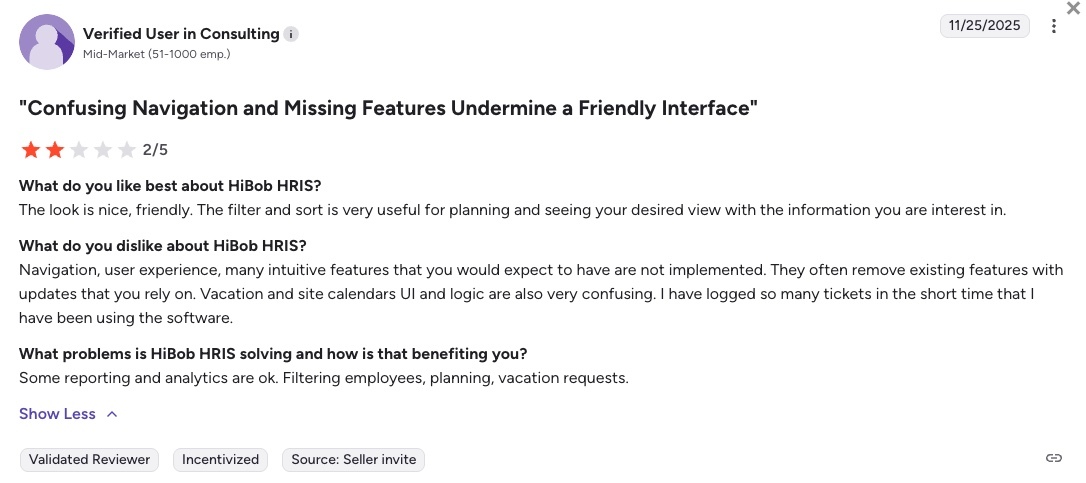
HiBob's strength is the experience. The platform is built around employee engagement and company culture, with social feeds, shout-outs, surveys, and a clean, modern interface that people enjoy using. For mid-sized companies that care about culture and want HR software that does not feel like a chore, Bob is genuinely strong. It also integrates with Slack and Microsoft Teams, has its Bob Companion AI assistant with MCP support, and carries a 4.5 out of 5 rating on G2.
The catch for Singapore teams
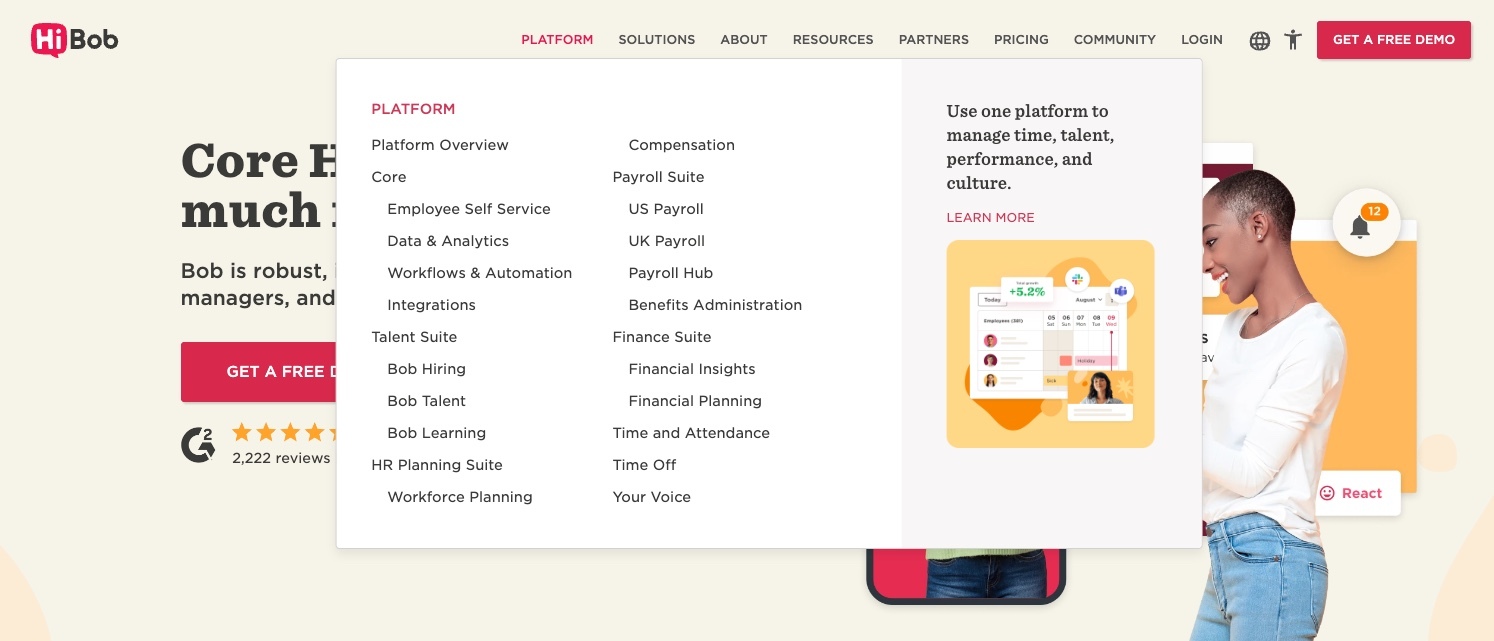
HiBob's native payroll covers the United States and the United Kingdom only. It does not run native payroll in Singapore or anywhere else in Asia. Its Payroll Hub syncs employee data to external payroll providers rather than processing payroll itself, so CPF, SDL, and IRAS filing still happen in a separate system. G2 reviewers note manual workarounds for payroll and limited workflow customization as a result.
Where BambooHR Wins
BambooHR's strength is simplicity. It is one of the easiest HR platforms to set up and run, with clean employee records, time off, onboarding, e-signatures, and a built-in applicant tracking system. Teams without a dedicated HR systems admin can adopt it quickly. It also offers Ask BambooHR, an AI assistant for employee questions, and holds a 4.4 out of 5 rating on G2.

The catch for Singapore teams
Like HiBob, BambooHR has no native Singapore payroll. There is no CPF, SDL, or IRAS support in the platform at any tier. To pay people in Singapore you connect a separate payroll provider, or use its Remote partnership for Employer of Record and contractor payments. Support is US-based, which can mean slower response times for teams working in Singapore time zones.
The Shared Gap: Singapore Payroll
This is the heart of the comparison. Both HiBob and BambooHR are excellent at HR records and, in HiBob's case, employee engagement. But for a Singapore team, neither closes the loop on payroll. CPF contributions, the Skills Development Levy, and IRAS filing all have to happen somewhere, and with both platforms that somewhere is a separate system.
The result is a two-system setup: one platform for HR data, another for payroll, plus the ongoing work of keeping them in sync. For a small team that may be acceptable. For a growing company running monthly payroll under time pressure, it adds risk and manual effort every cycle.
| Capability | HiBob | BambooHR | Omni HR |
|---|---|---|---|
| Singapore payroll (CPF, SDL, IRAS) | ❌ Syncs to external provider | ❌ None | ✅ Native |
| Malaysia payroll (EPF, SOCSO, EIS) | ❌ | ❌ | ✅ Native |
| Hong Kong payroll | ❌ | ❌ | ✅ Native |
| Philippines payroll (SSS, PhilHealth, BIR) | ❌ | ❌ | ✅ Native |
| Managed payroll across the rest of Asia | ❌ | ❌ | ✅ 20+ countries |
| EOR (hire without a local entity) | Via Deel/Remote | Via Remote partner | ✅ Native across Asia |
| Slack and Microsoft Teams | ✅ Both | Limited | ✅ Both |
Pricing
Neither platform publishes clear per-employee pricing, so buyers rely on quotes and third-party estimates. HiBob is typically estimated around $8 to $25 per employee per month per module, with an implementation fee of roughly 10 to 20 percent of the annual contract. BambooHR is estimated around $10 to $25 per employee per month, also with an implementation fee. For a Singapore team, remember that the cost of a separate payroll provider sits on top of either figure.
| Cost | HiBob | BambooHR | Omni HR |
|---|---|---|---|
| Starting price | ~$8-25/employee/mo per module (estimate) | ~$10-25/employee/mo (estimate) | $3/employee/mo (Core HR) |
| Implementation | ~10-20% of annual contract (estimate) | Quote-based fee | No published setup fee |
| Separate payroll provider needed for SG? | Yes | Yes | No, payroll is native |
| Pricing transparency | Quote only | Quote only | Published per employee |
AI Capabilities
Both platforms have AI. HiBob offers Bob Companion with support for the Model Context Protocol, and BambooHR offers Ask BambooHR for employee questions. Both can help with policy questions, time off, and surfacing HR data.
The limit, again, is payroll. An HR assistant is most useful when it can act across your real HR and payroll data in the markets you operate in. Because neither HiBob nor BambooHR runs native Singapore payroll, their AI cannot reach into CPF calculations or Singapore pay runs that live in a separate system.
The Third Option: Omni HR for Singapore HR and Payroll in One System
HiBob wins on experience and BambooHR wins on simplicity, but both leave Singapore payroll outside the platform. Omni HR was built for Singapore and the wider Asia region, and it closes that gap.
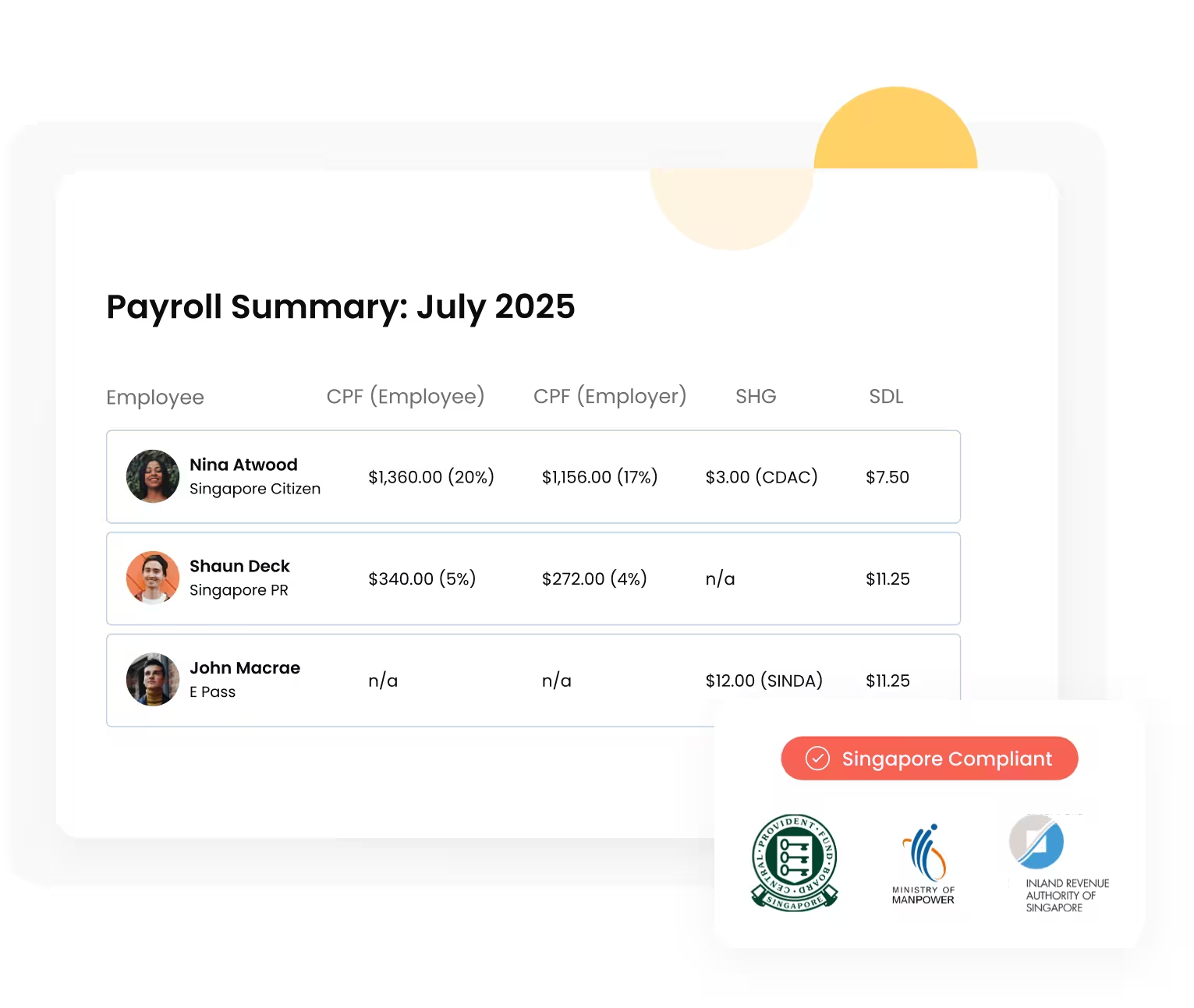
Omni HR runs native Singapore payroll, including CPF, SDL, and IRAS, in the same system as HR, with native payroll also in Malaysia, Hong Kong, and the Philippines, plus managed payroll across more than 20 countries in Asia. It integrates with both Slack and Microsoft Teams, includes an AI-assisted ATS and native performance reviews, and offers Mino agentic AI plus Connect AI that work across HR and payroll today. Pricing is published at $3 per employee per month with add-on modules from $1 and no published setup fee, and its G2 rating is 4.8 out of 5.
When to Choose HiBob vs BambooHR vs Omni HR
| Choose HiBob if... | Choose BambooHR if... | Choose Omni HR if... |
|---|---|---|
| Employee engagement and culture features are a top priority | You want the simplest possible core HR to set up and run | You need native Singapore payroll in the same system as HR |
| You want a polished, modern interface for a mid-sized team | You are a small to mid team with straightforward HR needs | You operate in Singapore and plan to grow across Asia |
| You are fine running payroll in a separate connected system | You are comfortable adding a separate payroll provider | You want one platform for HR, payroll, performance, and EOR |
| Budget allows for HR plus a separate payroll cost | Ease of use matters more than regional payroll depth | You want transparent pricing from $3 per employee per month |
Book a demo to see how Omni HR runs Singapore payroll and HR in one platform.
Further Reading
Frequently Asked Questions
Both are strong Western HR platforms, but neither runs native Singapore payroll. HiBob has a more modern, engagement-focused experience, while BambooHR is simpler to set up. For a Singapore team that wants HR and CPF payroll in one system, a region-built platform like Omni HR is often a better fit.
No. HiBob's native payroll covers the United States and the United Kingdom only. Its Payroll Hub syncs employee data to external payroll providers, so CPF, SDL, and IRAS filing happen in a separate system.
No. BambooHR has no native payroll in Singapore or anywhere in Asia at any tier. You need a separate payroll provider, or its Remote partnership for Employer of Record and contractor payments.
HiBob integrates with both Slack and Microsoft Teams. BambooHR has more limited integration for HR workflows. Omni HR integrates with both Slack and Microsoft Teams, which lets employees handle leave requests and approvals from chat.
Third-party estimates put HiBob around $8 to $25 per employee per month per module plus a 10 to 20 percent implementation fee, and BambooHR around $10 to $25 per employee per month plus a fee. For a Singapore team, the cost of a separate payroll provider sits on top of either. Omni HR publishes pricing at $3 per employee per month with native payroll included.
Neither runs native multi-country payroll in Asia. Both rely on external providers or EOR partners. Omni HR runs native payroll in Singapore, Malaysia, Hong Kong, and the Philippines, with managed payroll in 20-plus countries.
Omni HR is built for Singapore and Asia. It runs native CPF, SDL, and IRAS payroll in the same system as HR, integrates with Slack and Teams, and includes an AI-assisted ATS and native performance reviews, starting at $3 per employee per month.
HiBob offers Bob Companion with MCP support, and BambooHR offers Ask BambooHR. Both help with employee questions and HR data. Omni HR offers Mino agentic AI plus Connect AI, which work across HR and native payroll in four Asian markets, so the assistant can act on Singapore pay data directly.