



















Asia is where you grow next. Plan it market by market.
Asia Pacific is set to drive most of the world's growth, but it is not one market. It is a dozen economies, each with its own talent, costs and rules. Compare them side by side and choose your first or next market with confidence.

One region. Many markets.








Two very different starting points
We are choosing our first market
You need the business case, a shortlist and the lowest-risk way to test it. Most first entries start with an Employer of Record.

We are adding another market
You already know Asia is hard. See exactly what changes between the market you run today and the next one.
Why companies are moving here
Share of global growth
Asia Pacific is projected to generate nearly 60% of world GDP growth in 2026, more than North America and Europe combined.
Regional labour force
Asia Pacific's labour force stands at roughly 2.1 billion people, the largest working population of any region on earth.
Lower talent cost
Mid-level tech and professional salaries in SEA and South Asia run up to 70% below equivalent US roles, even before purchasing power gains.
Share of global middle class
Two in three of the world's middle-class consumers will be Asian by 2030, as regional consumer spending nearly doubles to $36 trillion.
What changes when you cross a border in Asia
No shared rulebook
There is no EU-style common framework. Each market has its own labour code, currency and statutory funds, and they do not talk to each other.
Contributions do not transfer
CPF, EPF, SSS and BPJS are separate systems. A new market means a new registration, a new filing calendar and a new rate.
The 13th month changes meaning
Required by law in the Philippines, a religious holiday allowance in Indonesia, and expected but optional in Singapore and Vietnam.
Ending employment costs differ
Severance runs from nothing in law to many months of pay, depending on the market and length of service.
Holidays move every year
Lunar New Year, Hari Raya and Songkran follow lunar or local calendars, so payroll and leave planning shift each year.
Work permits set the timeline
In some markets a foreign hire cannot sign a contract until the permit is approved. That wait sets your start date, not the offer.
The part that decides whether it works
Hiring is the easy part. Keeping a team together across very different workplace norms is where most expansions struggle.




Asia's key markets, side by side
Highlighted rules are required by law. Sources: official labour and statutory agency sites for each market. Rates verified September 2026.
Go deeper on one market

Singapore
Fastest, lowest-friction base in Asia; regional HQ hub with treaty access across SEA

Malaysia
Lower-cost alternative to Singapore with strong English-language talent

Philippines
World's largest English-speaking BPO and shared-services talent base

Hong Kong
Lowest statutory on-cost in Asia; gateway to Greater China capital markets
Fast-growing digital and fintech talent base
Young, fast-growing engineering and manufacturing workforce
Strong logistics, automotive, and tourism-sector talent
5M+ engineers, deepest tech bench in the region
Highly skilled, low-turnover professional workforce
Elite engineering talent in semiconductors and electronics
Deep engineering and advanced-manufacturing talent
World-leading chip design and hardware engineering talent
Expanding somewhere else?
Omni HR also hires through Employer of Record in 100+ countries, including Pakistan, Bangladesh, Cambodia and Sri Lanka. Coverage is table stakes. Real expertise is not, and ours is Asia.
What will your first hires actually cost?
Uses the same rates as the comparison table above. General guidance, not a quote.
Below about 14 people in one market, an Employer of Record is usually cheaper and faster than your own company in Philippines.
Three ways companies actually enter a market
Test with an Employer of Record
Hire one or two people without a local company. The fastest way to find out if a market is worth it.
Move to your own entity
Once headcount grows, register locally for full control over pay, benefits and hiring terms.
Run both at once
Most regional teams mix the two: an entity in one market and an Employer of Record in the next, managed side by side.
Clean cases with documents ready go live in 2 to 5 days; visa or work-permit cases take 1 to 2 weeks. Entity setup and payroll-readiness ranges from about 1 to 2 weeks in Singapore and Hong Kong to 3 to 4 months in China, so the right entry path depends heavily on the market.
Follow one hire from shortlist to dashboard
Find talent
One pipeline for every market, with local screening questions.
Hire compliantly
Local contract through our Employer of Record. No entity needed yet.
Pay correctly
Statutory contributions and the mandatory 13th month calculated for her market.
Run one culture
Shared goals and reviews, with each country's holiday calendar built in.
See it all
Headcount and cost across every market in one view.
Teams that made the move

“What differentiates Omni is how tailored it is to Southeast Asian market needs.”




Free tools for every stage of the move
Contractor or employee?
Six questions to check misclassification risk before you sign.
Questions teams ask first
Do I need a local company to hire in Asia?
No. An Employer of Record can legally employ people on your behalf while you test the market. Many teams move to their own entity once they have around 10 to 15 people in one country.
Which Asian country is cheapest to hire in?
On salary alone, usually markets like Vietnam, Indonesia, the Philippines, India or Pakistan. Employer contributions on top vary a lot by market, so compare the fully loaded cost, not just the salary.
Is 13th month pay mandatory in Malaysia?
No. It is required by law in the Philippines, and Indonesia requires a religious holiday allowance (THR). In Malaysia and Singapore it is common but set by contract.
Does CPF apply to foreign employees in Singapore?
No. CPF applies to Singapore citizens and permanent residents only. Foreign employees on work passes are not covered.
How long does it take to set up a company in Vietnam?
Typically 6 to 10 weeks, longer than Singapore or Hong Kong. That is why most first hires in Vietnam go through an Employer of Record.
What is the notice period in the Philippines?
Employees resigning must usually give 30 days' notice. Terminations for authorised causes also need 30 days' written notice to the employee and the labour department.
Can I run payroll for several Asian countries in one system?
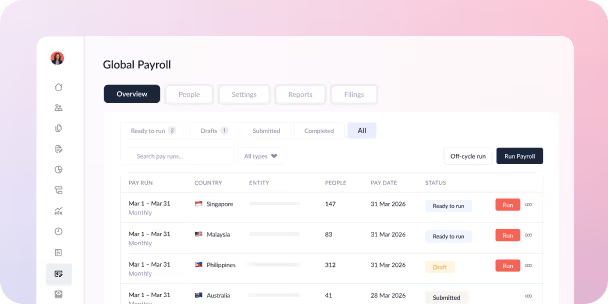
Yes. Omni HR runs local payroll across multiple Asian markets from one platform, with each country's contributions calculated locally. See the country guides for how each market is covered.
We already operate in Singapore. Which market should we add next?
Malaysia is a common next step for cost, and the Philippines for English-speaking talent. Use the "Your move" tool above to see what changes between your current market and the next.
Plan your next market with someone who has done it
A 30-minute call with an expansion specialist about your markets, headcount and timeline. No product demo unless you ask for one.
Book a 30-minute expansion callGet the playbook by email
The comparison table, the cost estimate and each new country guide as it is published. One email per guide, nothing else.
Figures are general guidance, not legal or tax advice. Sources: official labour and statutory agency sites for each market. Photos: Unsplash, placeholders until brand photography is ready.