















 SG
 MY
 PH
 HK






Every HR team we speak to is asking two questions right now: what should we pay for this role, and once we pay it, will people stay?
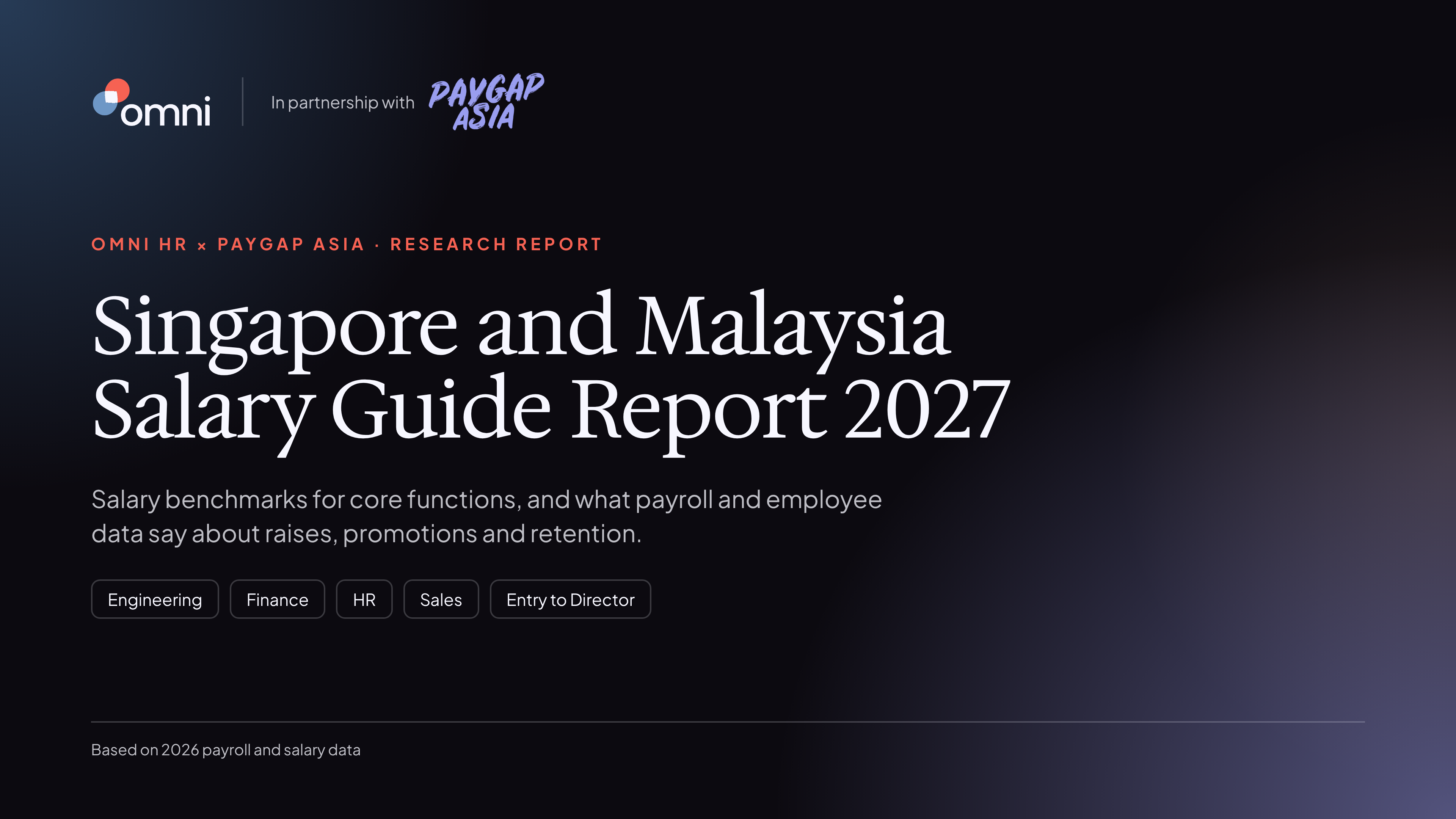
We set out to answer both in the Singapore and Malaysia Salary Guide Report 2027, produced in partnership with PAYGAP Asia. It brings together Omni HR's anonymized payroll data from 200+ employers across seven markets with 6,800+ salary records and 7,700+ sentiment responses from PAYGAP Asia. One side shows what employers pay. The other shows how employees feel about it, and that second view is where some of the most interesting findings came from.
To dig into what the numbers mean in practice, we brought together three people who work with them every day:
- Clarissa Wang, Head of People at Endowus, based in Singapore
- Joachim Ooi, Head of People at Coingecko, hiring across Malaysia and Singapore
- Edward Yeap, Co-Founder of PAYGAP Asia
Here's what they had to say.
1. Malaysian pay climbs much further with seniority
An engineering director in Malaysia earns about 6× what an entry-level engineer does. In Singapore, the same climb is about 3×. Median monthly base pay for Engineering runs from RM4,200 at entry level to RM25,000 at director in Malaysia, and from S$4,600 to S$15,000 in Singapore.
Edward said the pattern only became visible once PAYGAP Asia's data sat next to Omni HR's payroll data, and he reads it as Malaysia closing the distance at the top.
"For Malaysia itself, we are trying to catch up to the Singapore pay by increasing the steps. Even from entry to manager, we see a big increment, so there's a lot of opportunity for Malaysians." - Edward Yeap, Co-Founder, PAYGAP Asia
For Joachim, who hires in both countries, the steep curve reflects who you're competing with for senior people.
"We are also competing against talent from all across the region. In order for Malaysians to be competitive at that level, to be hiring good senior hires, you have to stay competitive when it comes to the base salary." - Joachim Ooi, Head of People, Coingecko
Clarissa brought it back to what a company chooses to pay for, and what employees count as progress.
"Are you paying for the role? Are you paying for the skills? Are you paying for what is needed? We try not to anchor on growth equals linear. We ask our employees, what does growth mean to you?" - Clarissa Wang, Head of People, Endowus
What this means for you: If you hire in both markets, benchmark each level separately. The gap between Singapore and Malaysia changes as people move up.
2. Promoted staff can still end up paid less than new hires
A promotion is worth 2.4 routine raises in Singapore and 2.8 in Malaysia. Even so, people promoted into a role in Singapore earn about 9% less than people hired into the same role from outside, at the same employer and level.
Clarissa said every company feels that tension, because the outside market moves faster than internal pay. At Endowus, the answer is a set of benchmarked bands, and a rule that new hires fit inside what the grade already pays.
"If they're sitting lower, the review cycle is where the existing employees catch up. The bands that we created have two roles to play. They keep us honest with the market, and they also keep us honest with the people that we already have."- Clarissa Wang, Head of People, Endowus
The report suggests budgeting promotions separately from the merit pool, at roughly 12 to 14%. Joachim said Coingecko already does this: ratings tie to bonuses, and promotions draw on a budget set aside for them.
"When we want to promote someone, it's always very important that they're already ready for the next level. They're already doing the next scope." - Joachim Ooi, Head of People, Coingecko
Because Coingecko benchmarks against Singapore for both teams, Joachim said they don't see the same gap between markets.
3. Fifteen months is a long wait for a first raise
22% of employees in Singapore and 26% in Malaysia have gone 12 months or more without any change to their pay. In Singapore, those employees are 3.9× more likely to resign than colleagues raised in the last six months, and the size of the raise made no measurable difference to whether people stayed. New hires wait a median of 13.9 months in Singapore and 15.0 months in Malaysia for their first raise, and more than a quarter leave within a year.
Clarissa read the data as an early warning sign rather than proof of cause. The report makes the same point: the same group is also more likely to be let go.
"You can give people a 20% raise, but then they wake up every morning and they dread going to work, and so that amount of money is not necessarily going to make any difference. It's really about how do you make people feel seen in the work that they do." - Clarissa Wang, Head of People, Endowus
Joachim's first reaction to the Malaysia number was simpler: "15 months is really long." Coingecko runs performance reviews twice a year, and every new joiner gets what the team calls a launch plan.
"Any new joiner that walks through the door, we give them what we call a launch plan, and this ranges between their first 90 to 180 days. It is always about the conversation, the touchpoints, the clarity." - Joachim Ooi, Head of People, Coingecko
Both panelists said they explain how pay reviews work before someone even starts. Clarissa covers it in the offer conversation, so new hires know when they'll be considered and when they won't.
"It's always good to be just upfront. They're so excited to hear about the offer, so it might slip their mind. Now, with everything being transcribed, I can be like, hey, actually, I said this in the call." - Clarissa Wang, Head of People, Endowus
4. A raise lasts a few months. Fulfillment carries the rest.
PAYGAP Asia's Malaysia data asks professionals how they felt about their last raise, how fulfilled they are at work, and whether they plan to stay. Among people paid within 20% of their peers, 80% of those very happy with their last raise plan to stay, against 36% of the very unhappy. A fulfilled employee paid at or below their peers is three times as likely to plan to stay as an unfulfilled one paid above them (75% vs 25%). Where pay sits against peers moves intent to stay by only 16 points from the lowest band to the highest.
Edward's takeaway for employers was about timing.
"Plan for your increment ahead of time, instead of making it something that's a post-review, where people already achieved what they achieved in the past year and the increment itself is just a reward for the past year." - Edward Yeap, Co-Founder, PAYGAP Asia
Joachim has seen how quickly the effect of a raise fades.
"Increment, I think who doesn't like it? But all these things only last probably about a couple of months. Then usually people start to be thinking of, okay, am I growing? Do I like what I do? That's where the fulfillment part comes in." - Joachim Ooi, Head of People, Coingecko
He sees managers as the ones who carry it from there, by setting expectations early. Even a heads-up that next year's increment may be smaller is one of the "tiny little conversations" that help people feel heard.
Clarissa splits fulfillment into two parts. Purpose, the sense that your work matters, is something a company can reinforce through all-hands, town halls and off-sites. Direction is harder, because it depends on how fast the business grows.
"Instead of hinting and implying that a promotion is around the corner, we can choose the tough conversation, and then help them find growth in scope and skills while waiting for that promotion. Or if that doesn't happen, then we just need to tell them directly." - Clarissa Wang, Head of People, Endowus
As I put it on the panel, clarity is kindness. People can change companies, but they can't bring their colleagues with them.
5. On a tight 2027 budget, the panel split
We asked both HR leaders where they'd spend a limited 2027 budget first: market adjustments, promotions or more frequent raises. They gave different answers.
Clarissa would put it into more frequent raises for high performers, the people a business leans on hardest when conditions are tough.
"Usually they're the people that the market is calling. With people knocking on their doors and the pressure turned on internally, we want to make sure that our strongest people know that we're paying attention, and we will be taking care of them." - Clarissa Wang, Head of People, Endowus
Joachim would start with market adjustments, to keep pay fair across the whole team.
"We have to look into more of the majority, and how we are trying to be equal as well, so that at least we don't have any imbalance happening within. I would definitely put my money on the market adjustments." - Joachim Ooi, Head of People, Coingecko
He also shared a change Coingecko is considering for next year: looking at total rewards alongside base pay. One example is raising outpatient medical claim limits, after conversations with the company's insurance provider showed how hard medical inflation is hitting employees in both countries.
Where to start in 2027
We closed by asking each panelist for one thing HR leaders could put in place next year. Here's that advice, alongside a few practices that came up along the way.
- Ask people what growth looks like for them. Clarissa's pick for 2027: "Have that conversation with your employees to know what growth looks like for them, and what's important to them."
- Share the benchmarks you use. Joachim recommends posting salary reports in an internal channel so people can see where the company pays. Coingecko pays at a minimum of the 75th percentile, and he said that makes its retention power stronger.
- Explain how pay works at the offer stage. Cover review cycles and when a new hire will first be considered, before day one.
- Give new hires a structured first 90 to 180 days. A plan with regular touchpoints keeps the first year from passing without a pay or career conversation.
- Budget promotions separately. Set promotions at roughly 12 to 14%, outside the merit pool, and check promoted staff against what you'd pay an outside hire.
- Read benchmarks as a range. Edward's advice to employees applies to employers too: look at the 25th, 50th and 75th percentiles, and ask where each person sits and why.
Pay data tells you where you stand against the market. The conversations around it decide whether people stay long enough for the next raise to matter.
Get the full report. Download the Singapore and Malaysia Salary Guide Report 2027 for salary benchmarks across Engineering, Finance, HR and Sales, plus the full findings on raises, promotions and retention.
Watch the full panel on demand.
Next in Webinars. We'll be back in January 2027 with another deep dive into the report's data from a different angle. Stay tuned on our social channels.
See Omni HR in action. Omni HR is an all-in-one HRIS and multi-country payroll platform built for teams growing across Asia. Run payroll, performance reviews and employee data across every market from one system. Book a demo